
01
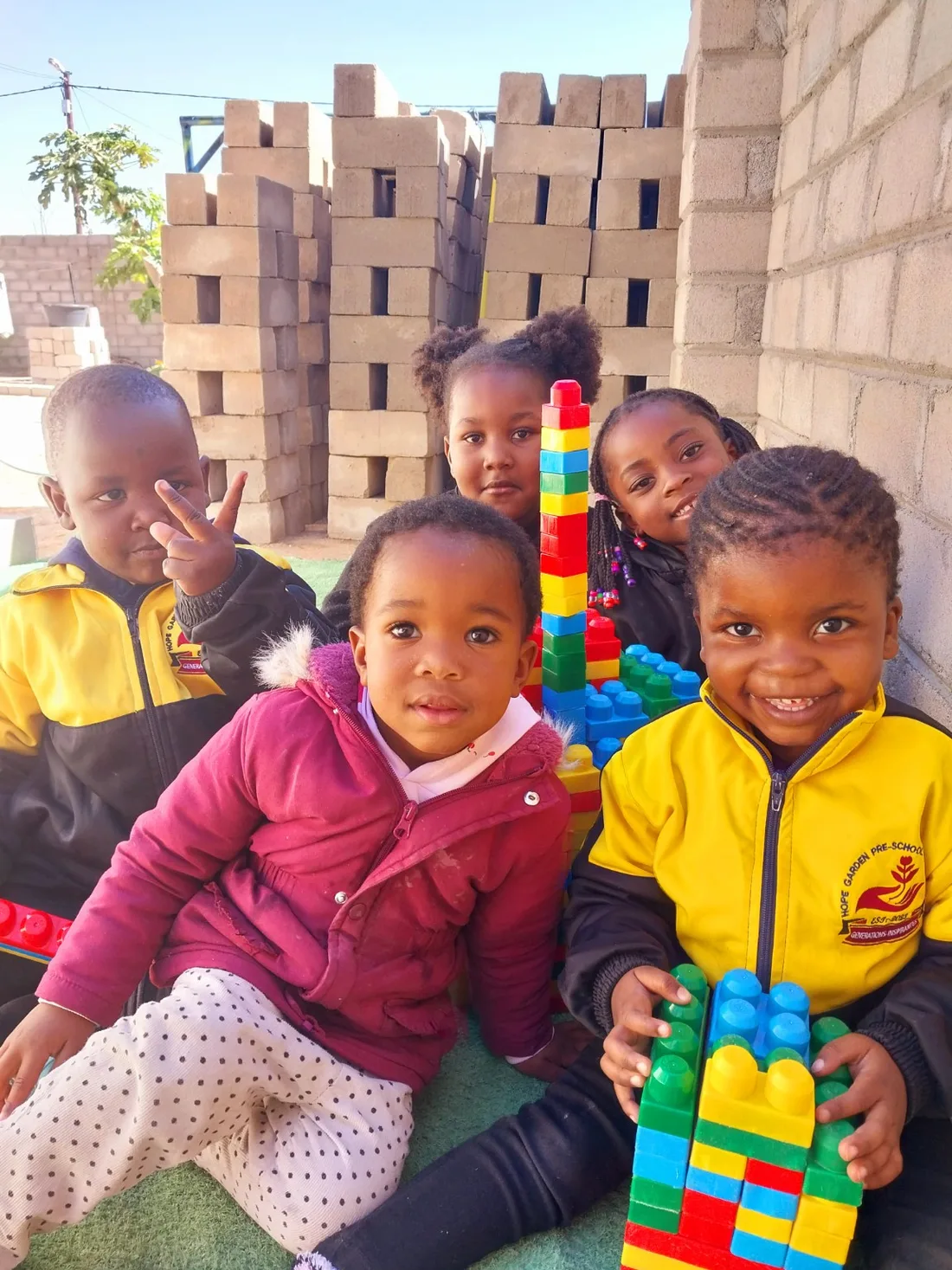
Toddlers
Security, language and confident beginnings
Warm routines, communication, sensory discovery, motor development and carefully guided social interaction.
PURPOSEFUL LEARNING. STRONG FOUNDATIONS.
Hope Garden combines nurturing relationships, structured teaching and purposeful discovery to develop confident, capable and values-driven learners.
English-medium learning with English First Language, Afrikaans Second Language and optional Otjiherero and German enrichment.
Every learning experience should develop knowledge, character, confidence and curiosity.
A CONTINUOUS PATHWAY
Each stage builds the language, thinking, independence and character required for the next.
Warm routines, communication, sensory discovery, motor development and carefully guided social interaction.
Play-based experiences strengthen curiosity, confidence, self-help skills, vocabulary and cooperation.
Learners build strong foundations in language, number concepts, creativity, listening and classroom routines.
Focused preparation supports phonological awareness, early writing, numeracy, problem-solving and positive learning habits.
Junior Primary is planned from 2028, subject to Ministry approval and institutional readiness. Grade 1–3 placements are not offered for 2027.
WHOLE-CHILD EDUCATION
Academic growth is strongest when thinking, communication, wellbeing, creativity and character develop together.
Listening, speaking, phonics, reading, writing and confident expression.
Number sense, patterns, measurement, reasoning and practical mathematical thinking.
Art, music, imaginative play, investigation and hands-on exploration.
Self-regulation, teamwork, kindness, confidence and responsible choices.
Respect, integrity, compassion, responsibility and service to others.
Movement, healthy routines, safety awareness and age-appropriate independence.
HOW LEARNING HAPPENS
Our learning cycle gives teachers a clear instructional framework while allowing children to explore, practise and communicate their understanding.
Ask About Our CurriculumTeachers introduce ideas through stories, demonstrations, conversation and meaningful questions.
Learners investigate through practical tasks, play, manipulatives, movement and guided discovery.
Skills are strengthened through carefully sequenced activities, repetition and individual support.
Learners explain, demonstrate and celebrate what they understand while teachers plan the next step.
LANGUAGE DEVELOPMENT
English is the medium of instruction and is developed as the school’s First Language. Afrikaans is introduced as a Second Language, while Otjiherero and German may be offered as optional enrichment.
Vocabulary, listening, speaking, reading and writing are intentionally developed during stories, mathematics, environmental learning, creative activities and daily routines.
VISIBLE PROGRESS
Progress information should be clear, age-appropriate and useful for deciding what each learner needs next.
Teachers observe participation, understanding, confidence and development during everyday learning.
Tasks and checks are matched to each programme and used to guide teaching rather than create unnecessary pressure.
Families receive clear feedback on strengths, progress, support needs and next learning priorities.
Meetings and digital communication help families reinforce learning and respond early where support is needed.
CONNECTED SCHOOL EXPERIENCE
Hope Garden’s digital systems help authorised families access communication and learner information, while classroom relationships and teacher judgement remain central to learning.
START THE CONVERSATION
Speak with the school, explore the programme that matches your child’s stage and prepare for the 2027 ECD & Pre-Primary admissions process.